Being a Sub in a Vanilla World
You are not leading a double life. You are carrying a private self through public rooms, and the discipline of keeping it whole, hidden, and yours is its own quiet kind of mastery.
 By Sir Linus From the June 2026 issue 7 min read
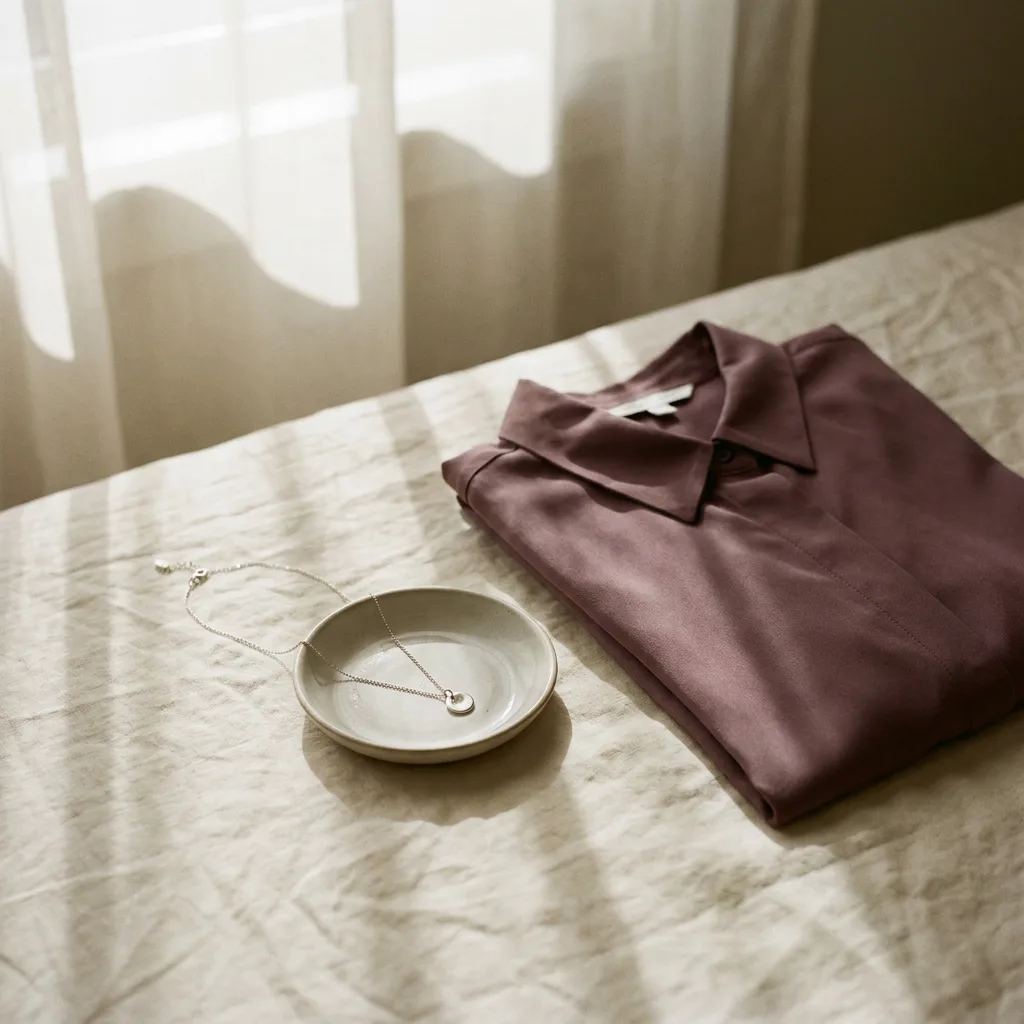
There is a particular silence I have watched a hundred women keep, and I want to name it because no one ever does. It is nine in the morning, she is in a meeting, someone is talking about quarterly something, and against her collarbone (under the blouse, under the lanyard, under the whole costume of competence) there is a thin chain that means a great deal and that not one person in that room will ever see. She runs the meeting. She is, by every visible measure, an ordinary professional woman in an ordinary vanilla world. And being a sub in a vanilla world is exactly this: not a confession waiting to happen, not a secret straining to get out, but a private architecture you carry through public rooms, intact, on purpose, and entirely your own. I have spent years watching women do this, and I am here to tell you it is not a double life. It is an undivided one that most people simply are not invited into.
What to take from this
- Keeping your submission private is not hiding or lying. It is privacy, the same discretion you already extend to every other intimate part of your life.
- You are not two people. You are one person with an inner room, and the discipline of keeping that room whole is itself a form of mastery, not a failure of integration.
- Disclosure is a decision you make for your own reasons, never a debt you owe to anyone who senses there is more to you.
Being a sub in a vanilla world: the word for it is privacy, not a double life
Let me take the heaviest word off your shoulders first, because the culture loads it onto you the moment you start asking these questions. Double life. It arrives soaked in shame: duplicity, deception, a wife with two phones. And it does not describe you at all. You are not deceiving the colleague who does not know what your evenings hold any more than she is deceiving you by not narrating her marriage at the printer. There is a clean and ancient line between a secret and a private matter, and almost everything about your submission lives on the private side of it.
A secret is something you are obligated to disclose and are concealing instead. A private matter is something nobody has standing to ask about in the first place. Your mother does not have standing. Your manager certainly does not. The friend who keeps hinting that you seem different lately does not. The kink you carry belongs to the same drawer as your sexual history, your therapy, your faith or lack of it, the contents of your prayers: things a whole and dignified adult is entitled to keep behind a door. Discretion is not the tax you pay for being unusual. It is the ordinary furniture of an interior life, and you were always allowed to have one.
So when the old framing rises in you (that you are getting away with something, that you are wearing a mask), set it down. You are not masked. You are dressed. There is a difference, and it matters, because shame metabolizes very differently depending on which word you feed it.
You are not split; you have an inner room
The fear underneath the question is rarely about getting caught. It is about coherence. If this is real, and the woman in the meeting is also real, then which one is the actor? I want to dismantle that, because it has the architecture exactly backwards. The submissive you are in private is not a costume you remove the competent woman to reveal, and the competent woman is not a costume over the “real” submissive. Both are load-bearing. Both are true. The integrity is not in collapsing them into one visible self for everyone to see. It is in the fact that the same nervous system, the same values, the same spine runs through both.
I have noticed something the women I trust most all share: their submission and their authority in the world are not opposites fighting for the same body. They are made of the same material. The capacity to surrender deliberately and the capacity to lead a room both require knowing your own mind well enough to spend it on purpose. The discipline you bring to being good at your work is recognizably the discipline you bring to being good at this. Far from fragmenting you, a well-kept private self tends to steady the public one. The room behind the door is where you are most yourself, and a person who has somewhere to be most themselves is harder to rattle, not easier.
This is also why the contract you may keep with him does not leak. A structure that is genuinely yours does not need an audience to stay real. It is real in the keeping.
You gave nothing away. Your sister saw a pretty necklace and told you so, and that is precisely all she saw. The discretion of a day collar is doing exactly what it was designed to do. The heat you felt was not exposure. It was the private meaning brushing up against the public world and your body bracing for a collision that never came. Notice that nothing actually happened. You said something vague, she moved on, the necklace stayed yours.
Wear it. Wear it to dinner, wear it to the family thing, wear it precisely because it carries a meaning only you and one other person hold. That is not a risk you are running; it is the entire elegance of the object. A thing can be deeply significant to you and merely pretty to everyone else, and that gap is not a danger to manage. It is a small, well-kept pleasure: a piece of your inner room that you get to take out into the daylight, hidden in plain sight, answerable to no one’s reading of it but your own.
When, and whether, to let anyone in
None of this means the door must stay shut to everyone forever. Some women want at least one person in their daylight life who knows: a close friend, a sister, eventually a partner if the partner came after the knowing. That is a fair want, and I will not pretend the closed door costs nothing; carrying something alone, even gladly, is still carrying it. But I want you to make that choice as a free decision and never as a payment.
Here is the rule I would give you. You disclose because you want a particular person to know you more completely: for your reasons, on your timing, into hands you have reason to trust. You do not disclose because someone has sensed there is more to you and is now pressing on the seam, or because a relationship has reached some imagined intimacy threshold where withholding feels like a debt. Curiosity is not a subpoena. The friend who says I feel like there’s a whole side of you I don’t know is making an observation, not issuing a demand, and your warmth toward her does not obligate you to hand over the map.
When you do choose to tell someone, a few things are worth holding in advance. Tell one person at a time, not a room. Tell people who have already shown you they can hold complexity without flinching; you have years of evidence about who those people are. And separate, in your own mind, the wish to be known from the wish to be understood. You can give someone the fact of you without owing them a defense of it. “This is part of my life, and it is good for me, and I’m telling you because you matter to me” is a complete sentence. You are not required to make it make sense to them. You are only choosing to let them stand a little closer.
And if you decide to tell no one, ever, and to keep the whole of it behind the door for the rest of your life, that is not a smaller or more frightened way to live it. The woman in the nine o’clock meeting with the chain against her collarbone is not getting away with anything and is not waiting to be found out. She is simply a person with a self that is hers, carried whole through a world that did not earn the right to see all of it. The door is yours. Who walks through it, and when, and whether anyone ever does, was always going to be the one thing in all of this that you alone decide.